How to Terminate Parental Rights in Virginia: 2 Legal Paths
Learn how to terminate parental rights in Virginia, including the two legal paths, key steps, and what to expect in both voluntary and involuntary cases.
Searching for how to terminate parental rights in virginia often means you need clear answers quickly. You may be considering a stepparent adoption, responding to a DSS case, or trying to protect a child from ongoing harm. Virginia treats parental-rights termination as permanent, so the court carefully reviews the child’s safety, needs, relationships, and future stability. The parent’s conduct, contact, support, service history, and ability to provide safe care may all matter. This article explains what the process can involve, what evidence may support or oppose termination, and why speaking with a Virginia family-law attorney before taking action is important.
Key Takeaways
- Virginia recognizes limited paths to termination: Parental rights usually end through a valid adoption process or a court order based on a statutory ground and the child’s best interests.
- The legal effects can be permanent: Termination may end custody, visitation, and decision-making authority, while support arrears and related financial issues may require separate review.
- Consider alternatives when termination is not appropriate: Custody changes, supervised visitation, protective orders, emergency custody, guardianship, or kinship care may address safety and stability concerns without ending the legal relationship.
Virginia’s Two Legal Paths
Virginia treats termination of parental rights as a permanent legal decision. It can end a parent’s authority to make decisions for a child, seek custody or visitation, or participate in major matters involving education and health care. Because the consequences reach far beyond day-to-day parenting, a difficult relationship or an ongoing custody dispute does not automatically justify termination.
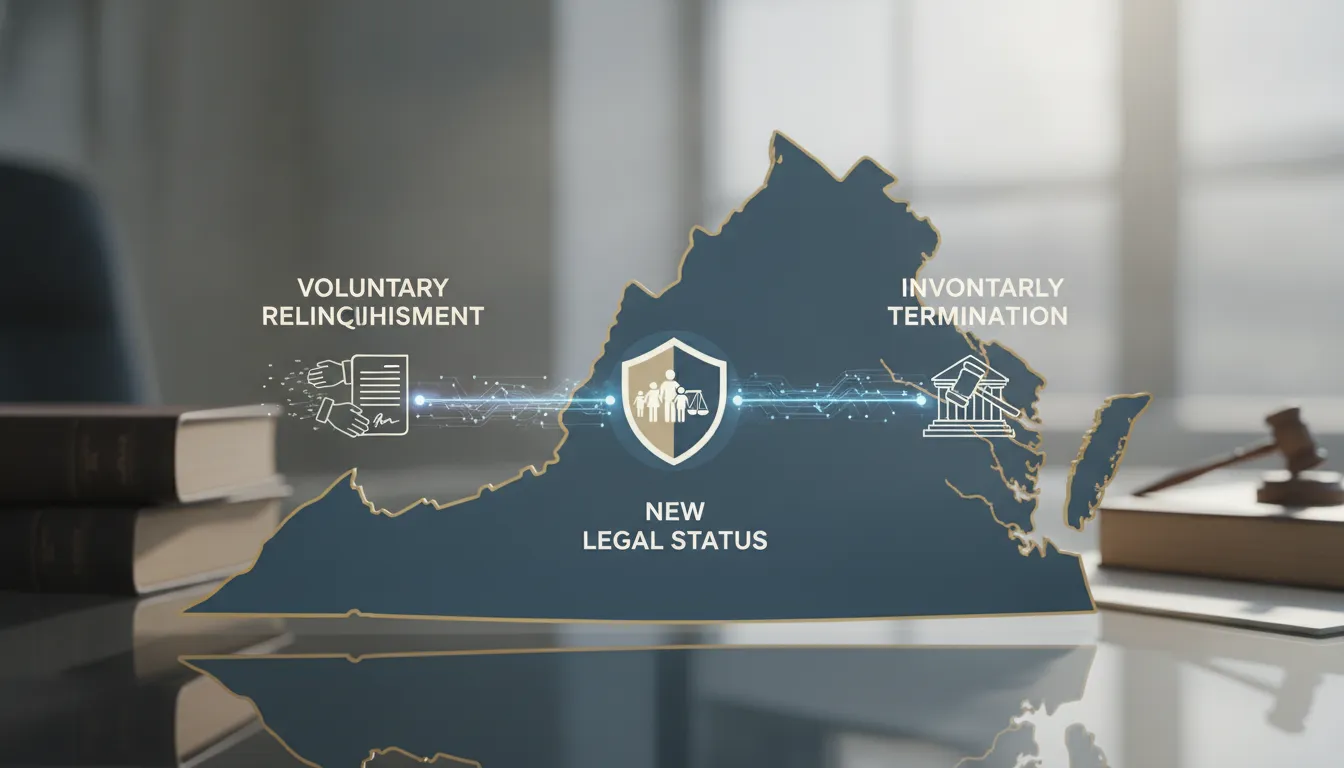
Most cases follow one of two paths: voluntary termination as part of a stepparent adoption, or involuntary termination through a court order. The appropriate path depends on the child’s circumstances, whether a stepparent is prepared to adopt, and whether the Department of Social Services or another authorized agency is involved. Reviewing the Virginia adoption consent requirements with a family-law attorney can help a parent understand which process may apply.
End rights through stepparent adoption
A parent may voluntarily consent to the termination of parental rights when the child’s stepparent is ready and willing to adopt. Through the adoption, the stepparent assumes the legal rights and responsibilities of a parent, including responsibility for the child’s care and support. The process may also give the child a more stable legal family structure.
Signing a consent form does not, by itself, complete the termination. The adoption must meet Virginia’s requirements, and the court must determine that it serves the child’s best interests. Depending on the circumstances, the other parent may need to consent, receive notice, or have their consent addressed through a legal exception. Families can review general information from the Virginia Department of Social Services, but legal advice is important before signing any adoption documents.
End rights through a court order
Involuntary termination requires a court order and proof of a legally recognized ground. A parent generally cannot ask the court to terminate the other parent’s rights simply because that parent is absent, has not paid support, or has made poor choices. Those facts may be relevant in custody or support proceedings, but termination requires a more substantial showing.
Many involuntary cases begin with the Virginia Department of Social Services, a local department of social services, or a licensed child-placing agency, often after a child enters foster care. The court may consider the parent’s conduct, the child’s safety, offered services, and the likelihood of safe reunification under Virginia Code Section 16.1-283. A parent who receives notice should take every hearing and deadline seriously.
Why a parent cannot simply give up rights
A parent cannot end parental rights through a private agreement, a written statement, or a decision to stop participating in the child’s life. Virginia courts must protect the child’s interests, not just honor an adult’s preference. Termination may affect custody, support, inheritance, medical decisions, and the child’s legal connection to the parent’s relatives.
Voluntary consent generally occurs within a recognized adoption proceeding, most commonly a stepparent adoption. Without a qualifying adoption or an authorized agency case, the court may not have a legal basis to end the relationship. If the concern involves immediate danger, other remedies may be more appropriate, including emergency custody, supervised visitation, restricted contact, or a protective order.
What termination changes, and does not change
A final termination order ends the parent’s legal authority and relationship with the child. The parent generally loses the right to make decisions about education, health care, and other major issues. The parent also loses the right to seek custody or visitation. Termination may make the child eligible for adoption, but termination and adoption are separate legal events.
Termination does not automatically resolve every related issue. Existing child support arrears may require separate review, and an order ending parental rights does not guarantee that a specific person will adopt the child. It also cannot erase the child’s personal history or emotional connection to the parent. The legal effects are significant, which makes careful preparation and advice from a Virginia family-law attorney especially important.
What Grounds Support Termination in Virginia?
Virginia courts treat termination of parental rights as a serious, permanent decision. A judge must determine that ending the legal relationship serves the child’s best interests and that the evidence satisfies the required legal standard. In an involuntary case, the evidence generally must be clear and convincing, which requires more than allegations, family conflict, or a parent’s temporary hardship.
The legal grounds depend on how the case begins. A parent may consent to termination as part of a qualifying adoption, or a court may terminate parental rights without consent when the evidence supports a statutory ground. Virginia’s termination statute addresses circumstances involving abuse, neglect, abandonment, failure to correct dangerous conditions, and certain serious criminal conduct.
A parent’s consent does not automatically end parental rights. The adoption must meet Virginia’s legal requirements, and the court must still determine that it is in the child’s best interests. In an involuntary case, the court examines the parent’s conduct, the child’s safety and needs, the services offered, and the likelihood that the parent can provide appropriate care within a reasonable time.
Because termination can affect custody, visitation, support, inheritance, and future decision-making authority, parents and caregivers should obtain legal advice before signing documents or filing a petition. The specific facts, procedural history, and relationship between the child and each parent can significantly affect the outcome.
Give voluntary consent for adoption
A parent may voluntarily consent to termination when a stepparent or another approved person is prepared to adopt the child. In a stepparent adoption, the adopting spouse assumes the legal rights and responsibilities of a parent. The process is more than a private agreement between adults, however. It requires legally valid consent, proper notice, required reports, and court approval.
Virginia law sets rules for consent, including when consent may be given and when an exception might apply. The court must also determine that the adoption serves the child’s best interests. Before signing, a parent should understand whether consent can be withdrawn and how the decision may affect custody, contact, inheritance, and support.
The consent requirements appear in Virginia Code Section 63.2-1205. A family-law attorney can explain the legal effect of consent and identify issues that should be addressed before the adoption proceeds.
Address abuse, neglect, or unresolved foster-care conditions
A court may terminate parental rights when serious abuse or neglect places a child’s life, health, or development at substantial risk. Termination may also be considered after foster-care placement if a parent has not corrected the conditions that led to removal, despite appropriate services and a reasonable opportunity to do so.
These cases often involve a pattern rather than one isolated event. The court may review unsafe housing, untreated substance use, domestic violence, untreated mental-health concerns, repeated safety-plan violations, or other conditions affecting the child’s welfare. It may also consider the parent’s participation in services and whether the parent can provide safe care within a reasonable period.
The focus is the child’s safety and future welfare, not simply whether the parent has made some improvement. The Virginia child-welfare statute describes circumstances that may support termination following abuse, neglect, or foster-care involvement.
Prove abandonment, limited contact, or failure to support
A parent’s prolonged failure to maintain a relationship with a child may support termination, particularly when the parent had the ability to visit, communicate, provide support, or participate in planning for the child’s care. The court may consider whether the parent made consistent efforts and whether the lack of contact resulted from the parent’s choices or circumstances outside the parent’s control.
When a child is in foster care, failure to maintain continuing contact and make reasonable efforts to plan for the child may create evidence supporting termination after the required period. Relevant evidence can include visits, calls, letters, support payments, service participation, and communication with caregivers or the local department.
A parent who cannot pay the full support amount may still show meaningful effort by paying what is affordable, seeking employment, communicating with the child, and following the case plan. The Virginia Department of Social Services provides information about foster-care planning and family-reunification services.
Establish unfitness, aggravated circumstances, or serious crimes
Termination may be appropriate when a parent is legally unfit and the evidence shows that returning the child would not be safe or realistic within a reasonable period. The court may consider chronic abuse or neglect, repeated failure to correct conditions that caused removal, or conduct showing that the parent cannot provide proper care.
Certain aggravated circumstances may support termination without requiring the agency to provide reunification services in the usual manner. These circumstances can include severe abuse, torture, dangerous abandonment, or serious criminal convictions involving the child or another person. Virginia law specifically addresses crimes such as murder, manslaughter, felony assault, and sexual assault.
The precise facts and statutory subsection matter. A criminal charge is not automatically enough, and a conviction does not eliminate the court’s obligation to consider the child’s best interests. Parents and caregivers should review the applicable Virginia termination statute with counsel before making assumptions about the case.
Understand why conflict, incarceration, or nonpayment alone may fall short
Parental rights are not usually terminated simply because parents argue, communicate poorly, or disagree about parenting. A difficult custody dispute is not the same as an abuse-or-neglect case. Likewise, incarceration or missed child-support payments, standing alone, may not establish a statutory ground or prove that termination serves the child’s best interests.
The court may consider incarceration, but it can also examine the sentence length, the parent’s conduct, the child’s needs, contact during incarceration, available relatives, and the possibility of safe care after release. For support issues, the court may review income, earning capacity, payment history, voluntary unemployment, and reasonable efforts to contribute.
Parents should preserve records of visits, calls, payments, treatment, employment efforts, housing, and communication with the child or agency. These records can provide context for missed contact or payments. A Virginia Beach family-law attorney can help determine whether the evidence supports termination or whether custody, visitation, guardianship, or a protective remedy may better address the family’s needs.
How Does Voluntary Termination Through Stepparent Adoption Work?
Virginia does not generally allow a parent to end parental rights by signing a standalone waiver. In most voluntary cases, termination happens as part of a stepparent adoption. The stepparent agrees to become the child’s legal parent, while the other legal parent consents to the adoption or is found to have no legally required consent under the circumstances.
This process requires more than agreement between the adults. The court must receive the required pleadings, consents, notices, and reports, then decide whether the adoption serves the child’s best interests. The child’s age, the other parent’s relationship with the child, existing custody orders, and any history of support or contact can all affect the case.
A Virginia family-law attorney can help identify the correct court, determine whose consent is required, and address any disputed facts before the petition is filed.
Confirm stepparent-adoption requirements
The stepparent generally must be married to the child’s legal parent and willing to assume the full responsibilities of parenthood. That includes responsibility for the child’s care, support, education, medical needs, and other decisions. Adoption creates a permanent legal relationship, not simply permission for the stepparent to help raise the child.
The family should first review the child’s birth certificate, prior custody or support orders, and any existing adoption or guardianship records. These documents can help identify the child’s legal parents and determine who may need to consent or receive notice. Virginia’s adoption statutes explain the requirements, but the application of those rules depends on the facts of each family.
Obtain parent and child consent, or establish an exception
The parent whose rights will end usually signs a written consent to the stepparent adoption. The stepparent must also consent and agree to accept the legal duties of parenthood. Depending on the child’s age and circumstances, the child may need to consent as well. Virginia law provides exceptions in situations where consent is not required or cannot be obtained.
If the other parent refuses to consent, the adoption may still be possible, but the stepparent must establish a legal basis for proceeding without that consent. Evidence may concern abandonment, failure to maintain a meaningful relationship, failure to provide support, or another statutory ground. Disagreement with the adoption, standing alone, does not automatically justify ending the parent-child relationship.
Complete notice, investigations, and reports
The court may require an investigation or report before deciding whether to approve the adoption. Depending on the circumstances, the review may address the child’s relationship with the stepparent, the home environment, the family’s stability, and the child’s physical and emotional needs. The court may also request information from a local department of social services or another authorized agency.
Some stepparent adoptions may qualify for an exception or waiver of certain investigative requirements. Families should confirm that issue with the court or a lawyer rather than assuming an investigation is unnecessary. The Virginia Department of Social Services adoption information offers general guidance, but it does not replace case-specific legal advice.
File the petition and notify required parties
The stepparent typically starts the case by filing an adoption petition in the appropriate Virginia circuit court. The petition identifies the child, stepparent, legal parents, and requested relief. Supporting documents may include the child’s birth certificate, the stepparent’s marriage certificate, existing court orders, and signed consents.
The required parties must receive legally valid notice unless the court determines that notice is not required under an applicable exception. Incorrect service, missing documents, or filing in the wrong court can delay the case. Virginia’s circuit court forms and filing resources can help families locate general forms and information, although court staff cannot advise a party about legal strategy.
Attend the hearing and show that adoption serves the child’s best interests
At the hearing, the judge reviews the petition, consents, notices, investigation materials, and any objection. The stepparent may need to describe the relationship with the child and explain how the family plans to meet the child’s ongoing needs. The court may also consider the child’s adjustment, safety, education, medical care, and emotional well-being.
The judge must independently determine that the adoption serves the child’s best interests, even when the adults agree. Evidence of a stable home, an established parent-child relationship, and the stepparent’s willingness to assume permanent responsibility can help the court evaluate the petition. If the other parent contests the case, the court will also consider the evidence supporting the requested exception to consent.
Understand withdrawal, finality, and amended birth records
Consent does not always take effect in the same way or on the same timeline. Virginia law may allow withdrawal during a limited period, while consent given under other circumstances may become irrevocable sooner. The deadline can depend on how the consent was signed, whether the adoption petition was filed, and other case details. A parent should obtain legal advice before signing or attempting to withdraw consent.
If the judge enters a final order of adoption, the stepparent becomes the child’s legal parent. The other parent’s parental rights generally end, along with future custody and decision-making authority. The adoption may also lead to an amended birth certificate and affect inheritance, benefits, and other legal records. Existing support arrears and post-adoption contact questions should be reviewed with an attorney before the final hearing.
How Does an Involuntary Termination Case Work?
An involuntary termination of parental rights case begins when an agency asks the court to permanently end a parent’s legal relationship with a child without that parent’s consent. In Virginia, these cases often follow a child’s removal from the home and placement in foster care. The agency must prove a legal ground for termination by clear and convincing evidence and show that termination serves the child’s best interests.
This process can affect custody, visitation, decision-making authority, and the parent’s ability to object to a future adoption. A parent should treat every notice, service referral, hearing date, and deadline seriously. The Virginia statute governing termination of residual parental rights outlines the grounds and procedures the court must consider.
DSS, a local department, or licensed agency starts the case
A local department of social services or licensed child-placing agency usually files an involuntary termination petition. The case may begin after the agency removes a child from the home and places the child in foster care. The agency may later decide that returning the child home is unsafe or that the parent has not made enough progress to provide proper care.
The parent should receive formal notice of the petition and hearing. The documents should identify the legal grounds and facts supporting the agency’s request. A parent should review them promptly with a Virginia family-law attorney. Even when the allegations appear inaccurate, failing to respond or attend court can limit the parent’s opportunity to present evidence.
Address removal, foster care, and abuse-or-neglect findings
A child’s removal from the home does not automatically end parental rights. The agency must still prove the requirements for termination under Virginia law. Depending on the facts, the case may involve abuse or neglect, substantial harm, a parent’s failure to remedy unsafe conditions, or other statutory grounds.
The court may review the reason for removal, the child’s current safety, the parent’s conduct, and the likelihood of meaningful improvement. An abuse-or-neglect finding can support the agency’s case, but the court must still apply the termination standard and consider the child’s best interests. The Child Welfare Information Gateway’s overview of Virginia termination grounds provides additional background.
Follow foster-care plans and offered services
After a child enters foster care, the local department generally creates a foster-care plan. The plan identifies the conditions that led to removal and the steps the parent may need to take before reunification can occur. Services may include substance-use treatment, mental-health counseling, parenting education, domestic-violence intervention, housing assistance, and supervised visitation.
Completing services does not guarantee reunification, but consistent participation can help demonstrate progress. Parents should keep records of appointments, treatment attendance, drug screens, visitation, housing, employment, and communications with the agency. If a service is unavailable, unaffordable, or unsuitable, the parent should raise the issue promptly and in writing. The court may consider both the agency’s efforts and the parent’s response.
Respond to the petition, notice, counsel, and guardian ad litem
After the petition is filed, the parent may need to attend preliminary hearings, review agency records, answer allegations, file motions, and prepare for an evidentiary hearing. The parent should give counsel all relevant documents, witness names, treatment records, visitation information, and evidence that challenges the agency’s allegations.
A parent who cannot afford an attorney may qualify for appointed counsel under Virginia law. The court also generally appoints a guardian ad litem to investigate and represent the child’s best interests. The guardian ad litem may recommend an outcome that differs from what the parent or child wants. Parents should communicate respectfully with court-appointed professionals and direct legal questions to their attorney.
Attend the hearing and address the final order and appeal
At the hearing, the agency may present testimony from social workers, service providers, foster parents, medical professionals, teachers, and other witnesses. It may also introduce agency records and other evidence. The parent’s attorney can cross-examine witnesses, object to evidence, present the parent’s witnesses, and argue that the agency has not met its burden.
The judge decides whether the agency proved a statutory ground by clear and convincing evidence and whether termination serves the child’s best interests. If the court grants the petition, the final order ends the parent’s residual rights, subject to any available appeal. Appeal deadlines are strict. A parent should discuss possible errors, deadlines, and the record with counsel immediately. The Virginia Code’s termination provisions should be reviewed in light of the specific case.
Plan for placement or adoption after termination
Termination does not complete an adoption by itself. After the order becomes final, the child may remain in foster care, move to a relative’s home, or be placed with an approved adoptive family. The responsible agency must continue working toward a permanent placement that meets the child’s needs.
When DSS or a licensed agency has authority to place the child for adoption, it may have continuing reporting responsibilities while the adoption proceeds. Those reports can address placement efforts, the child’s adjustment, and the status of an adoption petition. After termination, the former parent generally no longer makes placement decisions or has custody and visitation rights, unless a separate legally enforceable arrangement applies.
Understand why an identified adoptive family may not be required
Virginia law does not always require an agency to identify a specific adoptive family before requesting termination. The court’s decision focuses on whether a statutory ground exists and whether termination serves the child’s best interests. An adoption placement may occur later, after the court addresses the parent’s legal rights.
The court may also terminate one parent’s residual rights without terminating the other parent’s rights. Each parent’s conduct, circumstances, and relationship with the child must be considered separately. For example, one parent may be unable to provide safe care while the other remains able to do so. The Virginia Code explains that terminating one parent’s rights does not necessarily affect the other parent’s rights.
What Evidence Supports an Involuntary Termination Case?
Involuntary termination of parental rights is one of the most serious actions a Virginia court can take. The party seeking termination must present reliable evidence showing that a legal ground exists and that ending the parent-child relationship serves the child’s best interests. Courts generally review the full history of the case, rather than focusing on one missed visit, late payment, or disagreement between parents.
Evidence may include social services records, court orders, visitation logs, treatment records, school or medical information, witness testimony, and communications between the parties. Because termination is usually permanent, anyone involved should speak with a Virginia family-law attorney as soon as possible.
Prove a statutory ground by clear and convincing evidence
The petitioner must prove at least one statutory ground by clear and convincing evidence. This standard requires more than a showing that the claim is probably true. The court must also find that termination is in the child’s best interests.
Virginia Code § 16.1-283 identifies circumstances that may support termination, including serious abuse or neglect, failure to correct conditions that led to foster care, abandonment, and other forms of parental unfitness. The appropriate ground depends on the facts and procedural history of the case. Families can review the Virginia grounds for involuntary termination to understand the general framework, but legal advice is still important when applying the law to a specific situation.
Review agency records, testimony, and service history
In many cases, the local department of social services or a licensed child-placing agency provides important evidence. Records may include investigation reports, foster-care plans, safety assessments, visitation notes, referrals, provider updates, and documentation of services offered to the parent.
The court may also hear from social workers, foster parents, relatives, therapists, medical professionals, teachers, and other witnesses with firsthand knowledge. Virginia Code § 16.1-283 allows the court to terminate one parent’s residual parental rights without automatically terminating the other parent’s rights. An attorney can review the records for missing information, inaccurate statements, or evidence that supports the parent’s position.
Document parenting efforts, contact, support, treatment, and stability
A parent’s consistent efforts can matter greatly. Useful records may include visitation calendars, text messages, transportation receipts, child-support payments, service certificates, counseling records, drug-screen results, housing documents, and proof of employment or other stability.
Parents should keep a clear record of attempts to contact the child, attend visits, communicate with social services, and follow court orders. If a visit was canceled, save the notice and any request for a replacement visit. If a recommended service was unavailable, unaffordable, or scheduled at an unreasonable time, written proof may help explain the circumstances.
Parents should also avoid conduct that could create additional concerns while the case is pending. Follow court orders, communicate respectfully, and consult an attorney before making decisions that could affect the case record.
Address the child’s safety, attachment, needs, and best interests
The child’s best interests guide the court’s decision. The court may consider the child’s age, developmental needs, physical and emotional safety, relationship with each parent, attachment to caregivers, and the parent’s compliance with court orders and service plans.
Evidence should address both current conditions and the reasonable likelihood of improvement. A parent may present proof of treatment, stable housing, appropriate visitation, parenting education, or a safe support network. The petitioner may present evidence of ongoing danger, repeated instability, unmet needs, or a lack of meaningful progress.
A Virginia termination guide explains that courts generally assess both a statutory ground and the child’s best interests. The focus is not simply whether a parent has made mistakes. The court must determine whether the legal requirements for termination have been satisfied.
Present evidence in response
A parent who opposes termination should respond to the allegations directly. This may involve filing a timely response, attending hearings, reviewing discovery, identifying witnesses, and collecting documents that correct or add context to the agency’s account.
The parent may also challenge incomplete records, unreliable statements, or conclusions that are not supported by firsthand evidence. Relevant proof can include consistent visitation, financial support, completed services, sobriety, medical care, safe housing, and efforts to maintain a relationship with the child.
Silence does not protect parental rights. A parent who receives a petition should take it seriously and obtain legal advice promptly. The general legal framework for termination proceedings explains why courts require clear and convincing evidence before ending the parent-child relationship.
Understand the risks of missing hearings or deadlines
Missing a hearing, failing to respond to a petition, or ignoring a service-plan deadline can seriously weaken a parent’s position. In some circumstances, the court may proceed without the parent, make findings based on the evidence presented, or consider the parent’s failure to participate as part of the overall case history.
Parents should update their address with the court and social services, read every notice carefully, and contact their attorney immediately if they cannot attend a hearing. Keep copies of filings, notices, service referrals, court orders, and communications.
A missed deadline may sometimes be addressed, but the available options are often time-sensitive. If a parent receives a termination petition or learns that a hearing has been scheduled, contacting a Virginia family-law attorney promptly can help preserve the opportunity to respond.
What Happens to Support, Custody, and Contact After Termination?
Terminating parental rights changes the legal relationship between a parent and child in lasting ways. The former parent may lose the right to seek custody, visitation, or decision-making authority. The order may also affect child support, inheritance, public benefits, birth records, and contact after adoption.
These effects do not begin simply because a parent signs a consent form, stops visiting, or agrees that another adult will provide care. In Virginia, parental rights generally continue until a court enters a formal order. The details also depend on whether termination occurs through a stepparent adoption or an involuntary court case.
Because the consequences can be permanent, review the proposed termination order, adoption paperwork, and any contact agreement with a Virginia family-law attorney before signing. Families can also review information from the Virginia Department of Social Services when child-support enforcement is involved.
Address future support and existing arrears
A parent’s child-support obligation generally continues while a support order remains in effect. Signing a consent form, moving away, or allowing another adult to care for the child does not automatically stop current support. Until the court enters an order that changes the legal obligation, missed payments may continue to accrue.
Termination or a related adoption order may end the obligation to provide future support because the former parent-child relationship no longer exists. It does not usually erase arrears, meaning child-support payments that became due before termination. Those past-due amounts can remain enforceable even after parental rights end.
The exact result may depend on the wording and timing of the court orders, as well as whether public assistance or a government agency is involved. Parents should obtain an updated payment history and ask an attorney how termination affects both current support and arrears.
End custody, visitation, and decision-making authority
Termination permanently ends the legal parent-child relationship. The former parent generally loses the right to seek custody, visitation, or decision-making authority based on that relationship. This may include authority over education, medical care, religious upbringing, residence, and other major choices.
The effect is not the same as a custody modification or supervised-visitation order. Those arrangements preserve the legal relationship while limiting how a parent exercises it. Termination removes the underlying parental rights.
Virginia courts treat termination as an exceptional remedy and consider the child’s welfare and best interests. Under Virginia Code § 16.1-283, terminating one parent’s residual rights does not automatically terminate the other parent’s rights. The court must address each parent separately. A parent who receives notice of a termination case should respond promptly and attend every scheduled hearing.
Understand the adoptive parent’s legal duties
When termination occurs as part of a stepparent adoption, the adoption order creates a new legal parent-child relationship. The adoptive parent takes on the rights and responsibilities of a legal parent, including responsibility for the child’s care, support, safety, education, and major decisions.
This differs from an informal caregiving arrangement. A relative, stepparent, or family friend may provide daily care without having full legal authority to consent to medical treatment, enroll the child in school, make decisions about relocation, or manage other parental responsibilities.
A Final Order of Adoption establishes the adoptive parent’s legal status. The order should be reviewed carefully because it may affect the child’s name, birth records, inheritance rights, and relationships with other relatives. An attorney can explain what duties begin when the order becomes final.
Address post-adoption contact and enforceability
Termination does not automatically preserve the former parent’s right to communicate or visit with the child. After an adoption, the adoptive parent generally makes decisions about contact unless a valid agreement or court order states otherwise.
Some families discuss continued contact before the adoption is finalized. Any arrangement should address specific details, such as visits, phone calls, video calls, messages, transportation, holidays, and communication with extended family. It should also explain what happens if the child’s needs or safety concerns change.
Do not rely on verbal promises. Ask a Virginia family-law attorney whether a proposed post-adoption contact agreement can be approved or enforced under the circumstances. The agreement should also be considered alongside the termination order and Final Order of Adoption. Contact arrangements cannot be used to preserve parental decision-making rights after termination.
Review inheritance, benefits, and birth-record changes
Termination and adoption may affect inheritance, life-insurance designations, public benefits, and eligibility connected to a legal parent-child relationship. A child may lose certain rights tied to the former parent while gaining rights through the adoptive parent. Existing wills, trusts, beneficiary forms, and benefit records may need review.
Families should also ask whether the child remains eligible for benefits based on the former parent’s employment, military service, disability, or other status. The answer can depend on the type of benefit and the language of the governing plan or law. Do not assume that termination produces the same result for every program.
An adoption may result in an amended birth certificate listing the adoptive parent as the legal parent. The child’s name may also change through the adoption process. Families can review Virginia vital-records information and confirm with the clerk or attorney which records will be updated and what documents are required.
What Alternatives Exist to Terminating Parental Rights?
Terminating parental rights is permanent and generally reserved for situations where preserving the legal relationship would place a child at serious risk or prevent a safe, permanent placement. In other cases, a different court order may address the concern without ending the parent-child relationship. The appropriate option depends on the child’s safety, each parent’s conduct, and the evidence available to the court.
Virginia courts decide custody and visitation based on the child’s best interests. Available arrangements may include limits on contact, supervised visitation, changes to decision-making authority, or temporary care by another adult. Reviewing Virginia’s custody and visitation statute can help parents understand the types of orders a court may consider.
Modify custody and visitation
A parent concerned about the other parent’s conduct may request a custody or visitation modification instead of pursuing termination. The court may change an existing order when circumstances have materially changed and the proposed arrangement serves the child’s best interests.
Depending on the evidence, a judge might award one parent primary or sole physical custody, reduce parenting time, require exchanges at a public location, or impose conditions on visits. A parent generally needs to present more than disagreement with the current schedule. Documentation of missed visits, threats, unsafe supervision, substance misuse, or other conduct affecting the child can show why a modification may be needed.
Seek sole custody, supervised visitation, or no-contact orders
Sole custody may give one parent responsibility for the child’s care and important decisions, but it does not always eliminate the other parent’s visitation rights. When some contact remains safe, the court may order supervised visits, shorter visits, or communication through a designated third party.
In more serious circumstances, a parent may ask the court to suspend visitation or prohibit contact with the child. The request should identify specific safety concerns and include supporting evidence. A no-contact provision may address in-person visits, telephone calls, text messages, social media, or contact through another person. An attorney can help determine whether the request belongs in a custody case, a protective-order proceeding, or both.
Request emergency custody or a Virginia protective order
When a child faces an immediate safety concern, a parent may seek emergency custody rather than wait for a standard custody hearing. The request should explain the facts showing an immediate risk of harm. A court may issue a temporary order and schedule a later hearing where both parents can respond.
A protective order may also address threats, violence, stalking, or other qualifying conduct. The Virginia courts provide information about protective orders and the filing process, including where a person may seek assistance. Bring clear details about what happened, when it occurred, and why protection is needed. If anyone faces immediate danger, call 911 rather than waiting to file court paperwork.
Understand what protective orders can and cannot change
A protective order can establish immediate boundaries, such as requiring a person to stay away, stop contacting another person, or leave a shared home. Depending on the circumstances and the terms issued, it may also address temporary possession of a child or other safety-related concerns.
A protective order does not automatically terminate parental rights or permanently change the parent-child relationship. It may restrict contact for the duration of the order, while long-term custody and visitation decisions may require a separate proceeding. Read the order carefully and follow every term. Violating it can lead to criminal consequences and may affect later custody decisions. When a protective order and custody order overlap, legal advice can help clarify which requirements apply.
Consider guardianship, kinship care, or caregiver arrangements
Guardianship or another caregiver arrangement may provide stability when a parent cannot safely provide daily care, but termination is not necessary or appropriate. A relative, such as a grandparent, aunt, uncle, or adult sibling, may be able to care for the child while preserving some connection with the biological parent.
Kinship care can give a child a familiar home and support system. The caregiver’s legal authority depends on the arrangement and any court order. Guardianship may allow the guardian to make important decisions while the parent retains certain rights. Before choosing an arrangement, families should discuss school enrollment, medical care, visitation, financial support, and the possibility of reunification. An attorney can explain whether custody, guardianship, or another option best fits the child’s needs.
Modify or enforce child support
Child support is separate from custody and visitation, although the issues often arise during the same family dispute. A parent who experiences a significant change in income, employment, custody time, or the child’s needs may request a support modification. The court applies Virginia’s statutory guidelines and reviews the circumstances presented.
If support is unpaid, enforcement may be available through the Virginia Division of Child Support Enforcement or the court. Keep payment histories, income records, notices, and prior support orders. Parents should not stop paying support because visitation is disputed, and they should not withhold visitation because support is unpaid. Each issue requires its own legal remedy. Review Virginia’s child support guidelines before requesting a change or responding to an enforcement action.
Use mediation and parenting-plan changes when safety allows
Mediation may help parents revise a parenting plan, establish communication rules, create safer exchange procedures, and resolve decision-making disputes without a fully contested hearing. It can be useful when both parents can participate safely and negotiate in good faith. If the parents reach an agreement, it may be submitted to the court for approval when appropriate.
Mediation is not suitable for every family. Serious violence, coercive control, threats, or an immediate risk to the child may require court protection instead. No parent should feel pressured to mediate when they cannot participate freely or safely. Virginia courts provide information about court-connected mediation services. Before signing an agreement that changes custody, visitation, or support, consider having a family-law attorney review it.
How Can Families Cope During Parental Rights Proceedings?
Parental rights proceedings can affect every part of family life. Parents may experience grief, guilt, fear, anger, shame, and uncertainty while they respond to court orders, agency requirements, and possible changes to their relationship with a child. Children may also feel confused, frightened, or caught between the adults they love.
Emotional support does not replace legal advice, but it can help family members make thoughtful decisions and follow through with important responsibilities. A family-law attorney can explain the legal process and deadlines. Counselors, trusted relatives, teachers, and community organizations can provide emotional and practical support.
Address grief, guilt, fear, anger, and uncertainty
Strong emotions are common during parental rights proceedings. A parent may grieve the loss of daily contact, feel guilty about past decisions, or become angry about agency involvement or the other parent’s conduct. These feelings do not determine whether someone is a good parent, but unmanaged stress can affect communication, decision-making, and compliance with court or agency requirements.
Start by identifying the emotions that are affecting daily life. A private journal, regular counseling appointment, support group, or check-in with a trusted person can provide structure. Research on emotional suffering during custody proceedings emphasizes the importance of acknowledging distress instead of ignoring it.
When possible, keep emotionally charged conversations away from children. If anger or fear makes it difficult to respond calmly, pause before sending messages, attending meetings, or discussing the case. An attorney can help separate emotional concerns from the legal issues that must be addressed in court.
Support children through attachment and loyalty conflicts
Children may feel caught between parents, relatives, foster caregivers, and other adults involved in the case. They may worry that showing love for one person will hurt someone else. Stress can appear as withdrawal, aggression, sleep problems, regression, trouble at school, or repeated questions about when they will see a parent again.
Adults should not ask children to take sides, deliver messages, or repeat private conversations. Reassure the child that the situation is not their fault and that adults are responsible for making decisions. Keep daily routines as consistent as possible, including school, meals, bedtime, and approved contact with important caregivers.
Children need honest answers, but they do not need every detail of the legal dispute. Family-separation guidance from Safe Horizon recommends recognizing attachment disruptions and loyalty conflicts while providing age-appropriate support. A child therapist can help identify changes in behavior and offer a safe place to discuss difficult feelings.
Seek trauma-informed counseling and peer support
A counselor with experience in trauma, family separation, child welfare, or high-conflict family matters can help parents and children process the situation without placing responsibility on the child. Trauma-informed care focuses on safety, trust, emotional regulation, and the effects of past experiences.
When choosing a provider, ask about their experience with parental rights cases and whether they can coordinate appropriately with an attorney, agency, or guardian ad litem. Parents may also benefit from a child-welfare support group, community organization, or trusted faith leader. Children may need separate support from a therapist, school counselor, or age-appropriate peer group.
Counseling records can sometimes become relevant in a legal proceeding. Before sharing case details or signing a release, ask both the attorney and provider how privacy works. Ongoing psychological support may help family members adjust during and after the proceeding, as discussed in research on support during judicial family separation.
Communicate with children in age-appropriate ways
Children deserve clear, calm explanations, but the amount of information should match their age and emotional maturity. A young child may need to know who will pick them up from school and when they will see a parent. An older child may ask about court, custody, or adoption and need a simple explanation of what those terms mean.
Use plain language and answer the question the child actually asked. Avoid promises about the outcome, negative statements about another parent, or predictions that may later change. You might say, “The adults and the court are making a plan to keep you safe. You can ask questions, and this is not your fault.”
Invite questions more than once. A child may not be ready to talk during the first conversation and may express concerns through behavior instead of words. Safe Horizon’s guidance on family separation offers additional suggestions for honest, age-appropriate communication.
Create safety plans and practical support
A safety plan should address more than immediate physical danger. It may include emotional support, transportation, medication, school communication, emergency contacts, approved visitation arrangements, and steps to take if someone violates a court order. Keep important phone numbers available and store copies of court orders in a secure but accessible place.
If there are concerns about abuse, threats, substance use, stalking, or unsafe exchanges, tell the attorney and appropriate authorities promptly. Do not arrange an informal meeting when a court order or safety concern requires a different plan. An attorney can explain whether emergency custody, supervised visitation, or a Virginia protective order may be appropriate.
Families may also need help with meals, child care, transportation, housing, or missed work. Ask trusted relatives, schools, local agencies, and community organizations about available assistance. Research on crisis-to-care planning after child removal highlights the importance of emotional, physical, and cultural safety, along with practical support for children and caregivers.
How Can Virginia Families Prepare for Court?
Court proceedings involving parental rights can feel overwhelming, particularly when a case involves DSS, foster care, adoption, or concerns about a child’s safety. Preparation begins with understanding the type of case, gathering reliable records, and getting legal advice before an important decision or deadline passes.
The steps you take will depend on whether the matter involves a stepparent adoption, an involuntary termination petition, custody, visitation, or another family-law issue. A family-law attorney can help you identify the legal questions, respond to court papers, and present information that addresses your child’s needs and best interests.
Contact B. Clay Chick PLC in Virginia Beach and Hampton Roads
Speak with a family-law attorney as soon as you learn that parental rights, custody, visitation, adoption, or DSS involvement may be part of your case. Early legal advice can help you understand your options before you sign an agreement, accept a service plan, or miss a hearing.
B. Clay Chick PLC assists families in Virginia Beach and throughout Hampton Roads with complex family-law matters. The firm can help parents, stepparents, relatives, and caregivers understand the court process, organize relevant records, and prepare for hearings involving parental rights.
Bring every document connected to the case to your consultation, including a summons, petition, court order, DSS letter, safety plan, foster-care plan, or adoption paperwork. If another parent or agency has hired an attorney, avoid assuming that an informal conversation protects your legal interests. Your attorney can explain what to say, what not to sign, and what deadlines require immediate attention.
Understand DSS, local departments, and licensed agencies
The Virginia Department of Social Services, a local department of social services, or a licensed child-placing agency may be involved in a parental-rights proceeding. An agency may investigate reports, arrange services, develop a foster-care plan, supervise visitation, and provide information to the court.
Virginia law permits involuntary termination proceedings under Virginia Code § 16.1-283. The agency may ask the court to terminate residual parental rights when it believes the statutory requirements have been met and termination is in the child’s best interests.
Ask which agency is involved, who your caseworker is, and what the agency expects from you. Keep copies of case plans, referrals, appointment records, drug-screen results, visitation logs, and written communications. If an instruction is unclear, request an explanation in writing and discuss it with your attorney before making a decision that could affect your case.
Learn the roles of legal aid, appointed counsel, and guardians ad litem
Several professionals may participate in the same case, but they do not all represent the same interests. Your attorney represents you. The agency’s attorney represents the agency. A guardian ad litem, often called a GAL, investigates and advocates for the child’s best interests. The GAL may speak with the child, parents, relatives, teachers, therapists, and service providers before making recommendations to the court.
Some parents may qualify for appointed counsel when a proceeding could result in the termination of parental rights and they cannot afford an attorney. The process for requesting counsel and determining eligibility can vary. Ask the court clerk or your attorney what steps apply to your case.
Legal aid organizations may also offer advice or representation to people who meet their income and case requirements. The Virginia Legal Aid website provides information about available services and local legal-help programs. If an organization cannot accept your case, ask whether it can refer you to another resource.
Find Virginia lawyer-referral and domestic-violence resources
If you need an attorney but do not know where to start, the Virginia State Bar lawyer referral service can help you locate a lawyer based on your legal issue and location. Ask whether the attorney handles parental-rights cases, stepparent adoptions, DSS proceedings, and related custody matters.
Safety concerns call for additional planning. Tell your attorney and the court if the case involves domestic violence, stalking, threats, or coercive control. The Virginia Family Violence and Sexual Assault Hotline offers confidential support and referrals. Call 911 if you face an immediate emergency.
Protect your personal information if someone may use it to threaten or locate you. Avoid sharing your address, schedule, children’s school details, or case information without first getting legal advice. An attorney can explain whether a protective order, supervised visitation, emergency custody request, or another remedy may apply. A protective order may provide safety measures, but it does not automatically terminate parental rights or resolve every custody issue.
Review Virginia statutes, forms, and court-clerk information
Use official court and legislative resources when reviewing filing procedures and legal requirements. The Virginia Judicial System forms page includes commonly used forms. The clerk of your local juvenile and domestic relations district court can provide administrative information about filing, hearing dates, copies, and courtroom procedures.
For a petition involving termination of residual parental rights, Virginia uses form DC-531 in juvenile and domestic relations district court. A form is only one part of a case, however. Filing it does not establish that the allegations are legally sufficient, service was proper, or the requested order should be granted.
Read every notice carefully and record the response deadline, hearing date, courtroom, and judge. Confirm whether you must appear in person or may attend remotely. Court clerks can explain administrative procedures, but they cannot advise you about legal strategy or predict the outcome. Direct those questions to a family-law attorney.
Bring documents and questions to a family-law attorney
An organized file helps your attorney understand the history of the case and identify missing information. Bring petitions, court orders, agency letters, case plans, text messages, emails, photographs, medical records, treatment records, school information, visitation logs, and proof of financial support. Include records showing completed services, stable housing, employment, counseling, substance-use treatment, or consistent contact with your child.
Do not delete messages or alter records, even if they are embarrassing or appear unfavorable. Preserve original files and create a timeline with dates, people involved, agency contacts, visits, missed visits, important events, and court appearances. Your attorney can determine which information may support your position and how it should be presented.
Prepare questions for the consultation. Ask what the other side must prove, whether you need to file a response, what evidence may help, and what could happen if you miss a hearing. Virginia courts generally require clear and convincing evidence before terminating parental rights, and the child’s best interests remain central to the decision. The Child Welfare Information Gateway’s overview of Virginia grounds for involuntary termination provides additional background, but your attorney can explain how the law applies to your specific circumstances.
Frequently Asked Questions
Can a parent voluntarily terminate parental rights in Virginia without an adoption?\ Usually, no. Virginia generally requires termination to occur within a recognized adoption proceeding, such as a stepparent adoption, or through an authorized agency case. A private agreement, written waiver, or decision to stop visiting does not end parental rights. Before signing consent documents, speak with a family-law attorney about their timing, finality, and legal consequences.
Is a parent’s absence or failure to pay child support enough for termination?\ Not by itself. The court may consider missed contact or unpaid support, but the party requesting termination must prove a statutory ground and show that termination serves the child’s best interests. The judge may also consider the parent’s ability to pay, efforts to stay involved, participation in services, and whether circumstances prevented regular contact.
What should a parent do after receiving a termination petition?\ Read the petition carefully, note every hearing date and deadline, and contact an attorney promptly. Gather court orders, agency records, visitation logs, payment information, treatment records, and proof of housing or employment. Attend all hearings and follow court or DSS requirements unless your attorney advises otherwise. Missing a deadline or hearing can limit the opportunity to respond.
Does termination automatically lead to adoption?\ No. Termination ends the parent’s legal rights, but adoption is a separate proceeding. A child may later be adopted by a stepparent, relative, foster parent, or another approved placement, but a specific adoptive family does not always need to be identified before termination is considered.
What alternatives may address safety concerns without ending parental rights?\ Depending on the circumstances, a court may modify custody, require supervised visitation, limit communication, grant emergency custody, issue a protective order, or appoint a guardian. These options can address safety while preserving the legal parent-child relationship. A Virginia family-law attorney can help determine which remedy fits the family’s immediate and long-term needs.