Guardianship vs Adoption Pros and Cons: What to Know
Get clear answers on guardianship vs adoption pros and cons, including legal, financial, and emotional factors to help you make the best choice for your family.
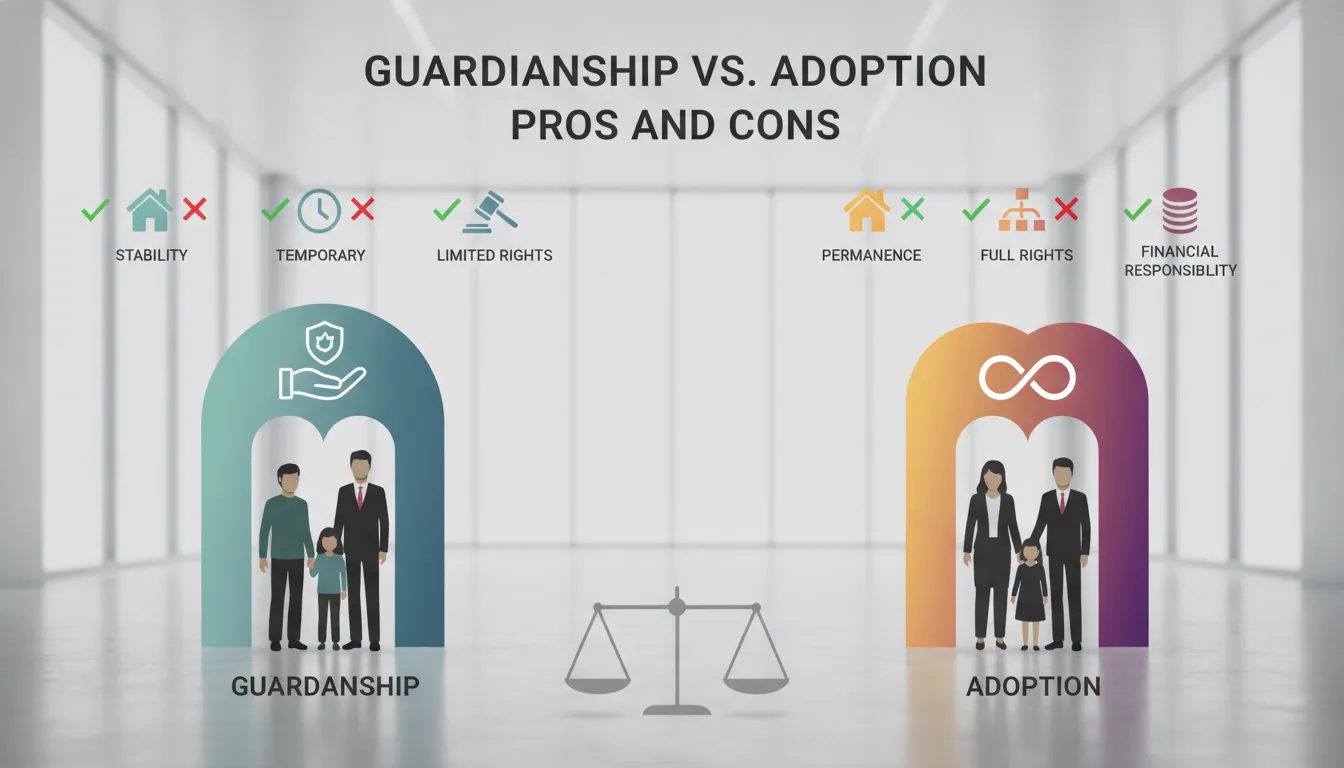
Legal terms can feel overwhelming when a child’s future is at stake. Guardianship and adoption are often discussed together because both may place a child with a caregiver who can provide safety and consistency. Their consequences are not interchangeable, though. Guardianship may allow continued contact with biological parents and preserve the possibility of reunification. Adoption generally creates a permanent legal family relationship and transfers full parental responsibility to the adoptive parent. Understanding the guardianship vs adoption pros and cons can help caregivers ask better questions before making a life-changing choice. For families in Virginia Beach and Hampton Roads, tailored legal guidance can address local court procedures and the child’s long-term needs.
Key Takeaways
- Guardianship and adoption serve different purposes: Guardianship grants a caregiver authority to provide care while preserving certain parental rights, while adoption creates a permanent legal parent-child relationship.
- Focus on the child’s future needs: Consider safety, reunification, family connections, decision-making authority, emotional well-being, financial support, benefits, and inheritance before choosing an arrangement.
- Prepare carefully under Virginia law: Confirm the proper court, gather relevant records, review existing custody orders, and understand consent, notice, home study, and finalization requirements before filing.
What Is the Difference Between Guardianship and Adoption?
Guardianship and adoption can both give a child a safe, stable home, but they create different legal relationships. Guardianship usually allows a caregiver to make decisions for a child while preserving some connection to the child’s biological parents. Adoption creates a new, permanent legal parent-child relationship.
The right option depends on the child’s safety, age, wishes, family relationships, and long-term needs. It also depends on whether a parent may eventually be able to resume care. A family considering either arrangement should look beyond the immediate need for a caregiver and consider decision-making authority, financial support, inheritance, and the effect on the child’s identity and relationships.
Virginia families should also consider which court has authority, whether another custody order already exists, and whether the case involves an out-of-state parent or military relocation. Reviewing the Virginia Department of Social Services adoption resources can provide helpful background, but general information cannot replace advice about a specific child or family.
Courts appoint guardians to provide care
A court appoints a guardian to care for a child and make decisions on the child’s behalf. Depending on the order, the guardian may handle housing, school enrollment, medical treatment, transportation, and daily supervision. The guardian takes on significant responsibility, but guardianship does not automatically make that person the child’s legal parent.
A guardianship may preserve some legal relationship between the child and the biological parents. A parent may retain rights involving visitation, communication, consent, or financial support unless a court order limits those rights. The specific authority granted to a guardian depends on the type of case, the court’s order, and the child’s circumstances.
Before accepting the role, a proposed guardian should understand exactly what the order allows. The Virginia Code provisions on guardianship can provide a starting point, but an attorney can explain how the law applies to the family’s situation.
Adoption creates a permanent legal parent-child relationship
Adoption changes a child’s legal family status. Once an adoption is finalized, the adoptive parent generally has the same rights and responsibilities as a biological parent. These responsibilities include providing care and support, making important decisions, and acting in the child’s best interests.
Adoption usually requires the birth parents’ valid consent or a court order terminating their parental rights. After finalization, the adoption is intended to be permanent. The adoptive parent assumes long-term responsibility for the child, and the child generally receives inheritance rights comparable to those of a biological child.
The process may involve notice, consent or termination proceedings, background checks, a home study, financial information, and a final hearing. If a parent objects, the court must address whether consent is required and whether the legal requirements for adoption have been met. The Virginia Judicial System’s adoption resources offer general information about adoption proceedings.
Compare permanence, reunification, and legal family status
Permanence is one of the clearest differences between guardianship and adoption. Guardianship may continue until the child turns 18, but it can also change or end if the court determines that doing so serves the child’s best interests. This structure may support a child’s stability while leaving open the possibility of safe reunification.
Adoption is designed to create a permanent family relationship. After parental rights are terminated and the adoption is finalized, reunification with a birth parent is generally no longer an option. Adoption may therefore be appropriate when a parent cannot safely resume care and the caregiver is prepared to accept a lifelong parental role.
The arrangements also affect the child’s legal family connections. Guardianship may preserve more of the child’s existing ties to birth parents and relatives. Adoption changes legal parentage, although adoptive families may still maintain safe and meaningful contact with siblings, grandparents, and other relatives. The child’s age, wishes, history, and relationships all deserve careful consideration.
Understand how each arrangement starts, changes, or ends
A guardianship case typically begins with a petition, notice to the parents and other required parties, supporting evidence, and a court hearing. The court may consider the child’s best interests, the proposed guardian’s ability to provide care, and the parents’ circumstances. The final order should explain the guardian’s authority and any limits on that authority.
An adoption case may involve consent, notice, a home study, background checks, financial information, and evidence addressing parental rights. If a parent contests the adoption, the court may need to decide whether consent is required or whether parental rights can be terminated under Virginia law.
Neither arrangement automatically becomes the other. A guardianship does not automatically turn into an adoption, and a guardian who later seeks to adopt generally must file a separate petition and meet additional requirements. Similarly, ending a guardianship usually requires court action rather than an informal agreement between the adults.
Check your local laws and procedures
Adoption and guardianship procedures vary by state. Virginia has specific rules addressing jurisdiction, notice, consent, parental rights, hearings, investigations, and final orders. The appropriate court may depend on where the child lives, where the parents live, whether a custody case is pending, and whether another state has issued an order.
Families in Virginia Beach and Hampton Roads should also determine whether the matter belongs in the juvenile and domestic relations district court or circuit court. Foster-care cases, military relocation, an out-of-state parent, and existing custody or support orders may create additional requirements.
Before meeting with an attorney, gather the child’s birth certificate, medical and school records, existing custody or support orders, and contact information for the parents and relevant relatives. The Virginia court forms and filing resources may help families locate general documents, but filing in the wrong court or using an unsuitable form can delay the case.
Guardianship is not always temporary
Guardianship is often described as temporary, but that description does not fit every case. A guardianship can continue for years and may remain in place until the child reaches adulthood. During that time, the guardian may provide the primary home, make school and medical decisions, and manage the child’s daily needs.
Guardianship still differs from adoption because the court retains authority over the arrangement. A parent may ask the court to modify or end the guardianship, and the court may review whether the order continues to serve the child’s best interests. The guardian may also have reporting or supervision obligations under the order.
Long-term guardianship can provide stability without permanently ending parental rights. That may matter when a parent’s circumstances could improve, when the child wants to preserve family ties, or when adoption does not fit the family’s goals. An attorney can explain the proposed guardian’s authority, the parent’s remaining rights, and the circumstances that could lead to a future change.
What Are the Pros and Cons of Guardianship?
Guardianship can give a child a safe, stable home without ending the biological parents’ legal relationship with the child. A court-appointed guardian may take responsibility for the child’s care, schooling, medical treatment, and daily needs while the parents retain certain rights and responsibilities. This can be helpful when a parent cannot provide care at the present time but may be able to do so later.
The arrangement also has limitations. Guardianship may involve ongoing court oversight, uncertainty about the child’s long-term placement, and limits on the caregiver’s authority. It may not provide the same legal status or permanence as adoption. The right option depends on the child’s safety, the parents’ circumstances, the caregiver’s goals, and the requirements of Virginia law.
Families in Virginia Beach and Hampton Roads can review the Virginia Courts’ guardianship information before speaking with a family law attorney. Because guardianship orders vary, caregivers should understand exactly what authority the court has granted, what responsibilities they will assume, and how the arrangement could change over time.
Preserve parental rights and family connections
One potential benefit of guardianship is that it allows a caregiver to raise a child while the biological parents retain certain parental rights. The guardian can provide everyday care without automatically creating the permanent legal parent-child relationship associated with adoption.
This structure may help preserve the child’s relationship with a parent through visits, phone calls, or other appropriate contact. It can also give parents time to address housing, health, substance use, or other concerns that affected their ability to provide care. The court’s order determines the scope of each parent’s rights, so guardianship does not guarantee a specific visitation schedule or level of involvement.
Support safety, stability, and possible reunification
Guardianship may be appropriate when a child needs immediate safety and consistency, but reunification with a parent remains possible. A guardian can provide a dependable home, regular routines, and an adult who can respond to the child’s needs while the parent works toward a safer and more stable situation.
Guardianship does not guarantee that reunification will occur. The court may continue to consider the child’s best interests and the circumstances affecting parental care. Families should discuss how the arrangement could affect future custody proceedings, especially when a parent’s situation is changing. Guardianship and adoption differ in how they address reunification, which makes the distinction important before filing.
Make medical, educational, and daily decisions
A guardian usually handles many practical responsibilities that a parent would ordinarily manage. Depending on the court’s order and applicable law, this may include enrolling the child in school, consenting to medical treatment, arranging services, and applying for public benefits.
Having one authorized decision-maker can prevent delays when a child needs care or an educational service. Guardians should still read the appointment order carefully. Certain decisions may require notice to a parent, additional court approval, or involvement from another agency. Keeping copies of the order and confirming documentation requirements with schools and medical providers can prevent problems later. Greenlight Family Services explains common school, medical, and benefit decisions a guardian may handle.
Maintain sibling, cultural, and extended-family relationships
Guardianship can help a child remain connected to siblings, grandparents, relatives, and important cultural or community traditions. A relative who becomes the guardian may already understand the child’s history, routines, language, and family relationships. That familiarity can reduce the disruption that often accompanies a change in caregiving.
A guardian can also work with parents and relatives to create safe, age-appropriate contact. Family relationships should support the child rather than expose the child to conflict or pressure. If relatives disagree about visits, communication, religion, or cultural practices, the guardian may need legal guidance. A written contact plan can clarify expectations, even when the court order does not address every family relationship.
Address limited permanence and parental challenges
Guardianship can last for a significant period, but it may not provide the same finality as adoption. A court may modify or end the arrangement if circumstances change, a parent seeks to regain custody, or another placement better serves the child. That possibility may be appropriate when reunification remains realistic, but it can also create uncertainty for the child and caregiver.
Parents may face challenges that affect the arrangement, including missed visits, disagreements about care, or difficulty meeting court requirements. The guardian may need to support the child through changing expectations while maintaining appropriate communication with the parents. Families should understand that a court may change or end a guardianship, rather than assuming the placement will continue unchanged.
Understand limits on major decisions and court approval
A guardian may make many day-to-day decisions without being the child’s legal parent. Major choices, however, may involve additional limits. Depending on the circumstances, court involvement could be necessary for matters such as changing the child’s residence, handling certain financial assets, or making decisions that affect the parent-child relationship.
These limits can matter when a guardian plans to move, wants to travel internationally with the child, or needs to consent to a significant medical procedure. The guardian should review the appointment order and ask an attorney what authority it provides. The Virginia Code provisions on guardianship offer a starting point, but they do not replace advice about a specific child or court order.
Manage court oversight and legal uncertainty
Guardianship is a court-supervised legal relationship, not simply an informal agreement between relatives. The guardian may have to file reports, provide information about the child’s care, or attend later hearings. The court may also review whether the arrangement continues to serve the child’s best interests.
This oversight can protect the child, but it adds paperwork, deadlines, and possible legal expenses. A guardian who moves or fails to respond to court notices may create avoidable problems. Before accepting the role, a caregiver should ask how often reports are required, what records to keep, and what events must be reported. American Adoptions discusses guardianship oversight and other differences between guardianship and adoption.
Plan for financial support and inheritance
Guardianship does not automatically make the caregiver financially responsible in the same way adoption changes legal parentage. A child’s parents may still have an obligation to provide support, depending on the court’s orders and applicable law. The caregiver should also investigate health insurance, public benefits, educational assistance, and other resources available to the child.
Inheritance requires separate planning. A guardianship appointment generally does not give the child the same automatic inheritance rights from the guardian that adoption may provide. The caregiver should review wills, trusts, beneficiary designations, and life insurance policies. When a child has a disability or receives means-tested benefits, an attorney can discuss whether a special-needs trust may be appropriate. Child support may continue during guardianship, but the details depend on state law and the court’s orders.
Weigh emotional continuity against prolonged uncertainty
Guardianship can preserve a child’s connection with biological parents while giving the child a consistent caregiver. That continuity may be especially valuable when the child is attached to siblings, relatives, school, culture, or community. At the same time, continued contact can be emotionally difficult if visits are unpredictable or parents disagree with the guardian’s decisions.
Children may also worry about where they will live long term. Caregivers can help by using age-appropriate language, keeping routines steady, and allowing the child to ask questions without taking sides. A court may consider the child’s age, maturity, and wishes, but those factors do not determine the outcome alone. Families should carefully weigh the benefits of preserving relationships against the uncertainty that can accompany a guardianship arrangement.
What Are the Pros and Cons of Adoption?
Adoption can give a child a permanent family and give caregivers the legal authority to make important decisions. Unlike guardianship, adoption generally creates a new legal parent-child relationship. The adoptive parent assumes responsibility for the child’s care, while the birth parents’ legal rights and responsibilities typically end when the adoption is finalized.
This permanence can provide stability, but it also makes adoption a serious, lifelong decision. Families should consider the child’s relationships, identity, health, financial needs, and long-term well-being. They must also complete legal steps involving consent, notice, background checks, home studies, and court approval.
The requirements can vary based on whether the adoption is private, agency-assisted, stepparent, relative, or through foster care. Virginia families can review general information from the Virginia Department of Social Services, but case-specific legal advice may be important when a parent objects, consent is unclear, or termination of parental rights may be required.
Provide permanent stability and full parental authority
Adoption gives the adoptive parent full legal responsibility for the child’s health, safety, education, and daily care. This can create a clear family structure, especially when returning to a birth parent is not safe or realistic. The adoptive parent can generally make decisions without requesting approval from a guardian, birth parent, or court.
The relationship is intended to continue throughout the child’s life. That permanence may help the child feel secure and allow the family to plan with greater confidence. It also means the adoptive parent accepts an ongoing commitment to care for the child, including meeting changing needs as the child grows.
Establish legal family and inheritance rights
Adoption generally gives a child the same legal status within the adoptive family as a biological child. This can affect inheritance, health insurance, family benefits, and the child’s legal relationship with relatives. Families can review the Virginia adoption statutes to learn more about adoption’s legal effects.
Adoption does not eliminate the need for estate planning. Parents should review wills, trusts, beneficiary designations, and life insurance documents after an adoption is finalized. These updates can help ensure that the child receives the intended inheritance and that the family’s plan accounts for special needs or other circumstances.
Simplify long-term medical, school, and travel decisions
Adoptive parents generally have authority to consent to medical care, communicate with schools, manage records, and make decisions about the child’s daily life. They can also handle practical matters involving passports, travel, insurance, counseling, and extracurricular activities without the uncertainty that may arise under a guardianship order.
This authority may be especially helpful when a child needs ongoing medical treatment, special education services, or a school change. Legal authority does not replace the value of hearing the child’s views or preserving safe family relationships. Parents can make age-appropriate decisions while respecting the child’s history, preferences, and changing needs.
Explore adoption assistance and related benefits
Some children adopted from foster care may qualify for adoption assistance. Depending on the child’s circumstances and the applicable program, support may include monthly payments, Medicaid coverage, reimbursement for certain expenses, or assistance with approved services. Eligibility can depend on the child’s placement history and the terms of an adoption assistance agreement.
Families should confirm available benefits before finalizing the adoption. They may also review the federal adoption tax credit and employer-provided assistance. The IRS adoption credit guidance explains potentially qualifying expenses and applicable rules. These programs do not replace a household budget, but they may help with medical care, counseling, childcare, and education costs.
Complete consent, notice, home-study, and court requirements
Adoption requires more than an agreement between a caregiver and child. Depending on the case, the process may involve written consent, notice to legal parents, background checks, financial information, a home study, and a court hearing. Requirements differ among private, agency, stepparent, relative, and foster-care adoptions.
If a birth parent does not consent, the court may need to determine whether parental rights can be terminated. Notice must be handled correctly, since an error can delay the case or affect the final order. Families should obtain legal guidance before filing documents or relying on an informal agreement about consent or contact.
Understand termination of parental rights and its consequences
Parental rights generally must end before an adoption can be finalized, unless a specific legal exception applies. This may occur through voluntary consent or a court order based on the applicable legal standards. After termination and finalization, the former parent typically no longer has authority to make decisions for the child or assert parental rights.
Termination can affect custody, visitation, inheritance, and the child’s relationship with the birth family. A parent considering consent should understand the documents before signing them. A caregiver should also avoid assuming that a parent’s absence automatically ends that parent’s rights. The court process and required evidence still matter.
Recognize that birth-family contact is not automatic
Adoption may end the legal relationship between a child and birth parents, but it does not necessarily erase every personal connection. Some families create an open-adoption plan involving letters, photographs, phone calls, visits, or contact with siblings and extended relatives. Any plan should be realistic, specific, and focused on the child’s well-being.
Families should understand that an informal promise may not offer the same protection as a court-approved agreement. Enforcement may also be limited, and courts generally consider the child’s best interests rather than treating contact as an unconditional right. Before finalizing an arrangement, discuss how contact may change as the child grows or safety concerns arise.
Address identity, grief, and changing family relationships
Adoption can bring security and belonging while also creating complicated emotions. A child may grieve the loss of a birth parent, sibling, familiar home, culture, or earlier identity. Older children may have memories and questions that require patient, honest support. As children mature, they may want more information about their birth family and adoption story.
Caregivers can support healthy identity development by preserving photographs, medical records, family stories, cultural traditions, and age-appropriate information about the child’s background. A counselor with adoption experience may help the family discuss loss, loyalty, belonging, and changing relationships. Support should continue after the court enters the final order.
Consider adoption’s finality and limited options for change
Adoption is designed to be permanent. After finalization, reversing the relationship is generally difficult and may not be available simply because circumstances change. Financial stress, family conflict, or parenting challenges do not ordinarily make adoption similar to a temporary placement.
Families should consider their readiness, support system, housing, finances, health, and ability to meet the child’s needs over time. They should also compare adoption with guardianship when reunification remains possible or preserving a child’s legal relationship with a birth parent is important. A Virginia family law attorney can explain the available options and the consequences before a family files or consents.
How Do Parental Rights, Decision-Making, and Family Relationships Differ?
Guardianship and adoption can both provide a child with stability, but they create different legal relationships. The key questions are who remains a legal parent, who can make important decisions, whether the arrangement can change, and how the child’s relationships with relatives may continue.
A guardianship usually gives a caregiver authority to care for the child without ending the birth parents’ legal status. Adoption generally creates a permanent parent-child relationship and ends the former parents’ legal rights and responsibilities. The exact outcome depends on the court order, the facts of the case, and the law that applies in Virginia.
Families should review the specific order rather than rely on general assumptions. The Virginia Code provisions addressing guardianship and adoption offer useful starting points, but a Virginia family-law attorney can explain how those rules apply to a particular child and family.
Compare birth parents’ consent, notice, visitation, and communication rights
In a guardianship case, the birth parents generally remain the child’s legal parents. The court may suspend or limit their custody and decision-making authority, but guardianship does not automatically end the parent-child relationship. Depending on the order, a parent may retain rights to notice of hearings, visitation, communication, or participation in certain decisions.
Adoption generally requires the birth parents’ consent or a court order terminating their parental rights. Before an adoption can proceed, the court must address notice, consent, and any objection. Virginia’s adoption consent statute explains when consent may be required and when an exception may apply. These issues can become complicated if a parent objects, cannot be located, or has not maintained contact with the child.
Compare guardians’ and adoptive parents’ authority
A guardian usually receives authority to care for the child and make many day-to-day decisions. This may include enrolling the child in school, arranging medical appointments, consenting to counseling, and managing routine activities. The guardian’s authority comes from the court order, however, so the order may contain limits or special conditions.
An adoptive parent becomes the child’s legal parent. That status generally includes the authority and responsibility to make decisions about the child’s care, education, health, and support without seeking permission from a former parent. Adoption also changes the child’s legal family relationships, including inheritance rights.
The Virginia Department of Social Services adoption resources provide information about adoption procedures and related services. Families should still obtain legal advice when an adoption involves contested consent, an existing custody order, or another complicated issue.
Manage medical care, education, mental health, travel, and records
Guardians and adoptive parents may both manage many practical aspects of a child’s life, but their authority may not be identical. A guardian can often consent to medical care, enroll the child in school, access records, and arrange mental health services. The guardian should review the order and confirm whether an agency, parent, or court retains authority over a particular decision.
Adoptive parents generally have broader and more permanent authority because they are the child’s legal parents. They can typically make decisions about treatment, education, counseling, records, and daily care without involving the birth parents. Travel and relocation may still involve separate custody orders, agency requirements, or court approval. Before planning a major move or extended trip, families should ask an attorney to review the governing documents and identify any restrictions.
Address child support and ongoing parental responsibilities
Guardianship does not necessarily end a birth parent’s financial responsibility. A parent may still be required to pay child support under an existing or new order. Support may help pay for housing, food, clothing, education, medical care, and other expenses, although obtaining or enforcing payments can create practical challenges.
Adoption generally ends the former parents’ legal duty to support the child because their parental rights have ended. The adoptive parents then assume responsibility for the child’s financial needs. Depending on the circumstances, an adopted child may qualify for adoption assistance, health coverage, or other services. Families should confirm eligibility and application deadlines before including a benefit in their financial plans. The Virginia adoption assistance program includes information about available support and related requirements.
Protect sibling, cultural, and birth-family relationships
Guardianship may help preserve a child’s relationships with birth parents, siblings, grandparents, and other relatives. The court can address visitation and communication, and caregivers may be able to support regular contact when it is safe and beneficial. Continued relationships can help a child maintain a sense of identity, family history, and cultural belonging.
Adoption does not require a child to lose every connection with the birth family. Adoptive parents may support visits, letters, calls, photographs, or other contact when it serves the child’s interests. They can also preserve family stories, records, traditions, and relationships with siblings. Any contact plan should account for safety, consistency, the child’s wishes, and the adults’ ability to maintain appropriate boundaries.
Understand open-adoption agreements and enforcement limits
An open adoption may include continued communication or contact between the child and members of the birth family. The plan might involve visits, telephone calls, letters, photographs, or updates through another agreed method. This contact can help a child understand their history, but it does not give the birth parents the same legal rights they held before adoption.
The enforceability of post-adoption contact depends on the agreement, the court’s involvement, and applicable Virginia law. Families should put expectations in writing and ask an attorney whether the terms can be included in a court order or enforced in another way. Informal promises may not provide guaranteed visitation rights. The Virginia adoption statutes address important issues involving consent, finalization, and adoption proceedings.
Consider the child’s age, wishes, and court participation
The child’s age, maturity, preferences, and individual needs may affect a guardianship or adoption case. A court may consider the child’s wishes as part of its best-interests analysis, especially when the child can express a thoughtful and independent preference. The child’s opinion matters, but it may not determine the result.
Virginia adoption law includes specific consent rules for children in certain age groups. For example, a child who is 14 or older may generally need to consent to an adoption unless a legal exception applies or the court makes the required finding. Guardianship proceedings may use different standards and procedures. Families should ask their attorney how the child may participate and how adults can discuss the case without pressuring the child to choose sides.
Guardianship does not remove every parental right
A guardianship usually limits a parent’s custody and decision-making authority rather than ending the parent-child relationship entirely. Depending on the court order, the parent may retain rights to notice, visitation, communication, or financial responsibility. A parent may also be able to ask the court to modify or end the guardianship if circumstances change.
That flexibility may make guardianship appropriate when a child needs protection and stability while reunification remains possible. It can also create uncertainty if the parent’s circumstances change frequently or the parties disagree about contact. The court will focus on the child’s safety, well-being, and best interests. Before accepting or seeking guardianship, caregivers should review the order carefully so they understand which rights remain and whether future hearings or reports may be required.
Adoption does not erase every family connection
Adoption creates a permanent legal parent-child relationship, but it does not erase a child’s personal history. A child may continue to care about birth parents, siblings, grandparents, and other relatives. Questions about identity and family background may become more important as the child grows and understands the adoption more fully.
Adoptive parents can support healthy connections by preserving records, sharing age-appropriate information, honoring cultural traditions, and maintaining safe contact when appropriate. They should also recognize that relationships may change. A contact plan that works for a young child may need different boundaries as the child becomes older. Thoughtful planning should center the child’s safety and emotional needs while respecting the child’s family history.
How Should Families Choose Between Guardianship and Adoption?
There is no universal answer to whether guardianship or adoption is better. The appropriate choice depends on the child’s safety, relationships, needs, and the caregiver’s ability to provide consistent care. Families should look beyond the immediate crisis and consider which legal arrangement can support the child over the next several years.
The decision may affect parental rights, medical and educational decisions, family contact, financial support, inheritance, and the child’s sense of identity. It can also affect the caregiver’s authority to make everyday decisions. A Virginia family law attorney can explain the available options, review existing court orders, and identify concerns that may not be obvious at the beginning of the process.
Families should also consider whether a custody order, foster placement, or limited authorization could address the immediate need. These options may not provide the same rights as guardianship or adoption, but they may be relevant while the family develops a longer-term plan. The Virginia Department of Social Services’ child welfare information provides general background on foster care and related services.
Prioritize the child’s immediate safety and long-term stability
Start with the child’s immediate safety. Consider whether the child has a safe home, reliable supervision, medical care, and protection from neglect, abuse, or ongoing conflict. If the child is in immediate danger, contact emergency services or the appropriate child-protective services agency before focusing on the long-term legal arrangement.
After addressing immediate concerns, consider which option can provide dependable care over time. Guardianship may offer stability while parental rights remain in place or reunification remains possible. Adoption may provide greater permanence when returning the child to a parent is not safe or realistic. Virginia courts focus on the child’s best interests, so families should gather records that clearly describe the child’s circumstances.
Assess the likelihood and timing of safe reunification
Ask whether a parent may be able to resume safe care, and if so, when. The answer may depend on treatment, housing, mental health care, incarceration, domestic violence, physical illness, or other circumstances. A temporary crisis may call for a different plan than a long-standing pattern of unsafe parenting.
Guardianship may be appropriate when a child needs a stable caregiver but maintaining the legal relationship with a parent remains important. Adoption may be more suitable when the child needs a permanent home and reunification is unlikely. Families should avoid promising a specific return date unless the parent’s progress and the court’s orders support that expectation. An attorney can review custody, visitation, and protective orders before the family chooses a legal path.
Consider the child’s age, wishes, health, education, and needs
A child’s age and maturity should be part of the discussion. Older children may have strong feelings about where they want to live, whether they want contact with a parent, and how they understand guardianship or adoption. Their views may not determine the outcome, but ignoring them can make an otherwise sound plan emotionally difficult.
Families should also consider medical, educational, developmental, and mental health needs. Does the child need specialized treatment, counseling, or an individualized education plan? Think about transportation, activities, religious practices, and daily routines. The caregiver should collect relevant records and ask how each legal arrangement could affect consent, privacy, and continuity of care. Virginia’s court information about guardianship offers general guidance, but it does not replace advice about a specific child.
Evaluate the caregiver’s readiness for a permanent commitment
Adoption is a permanent legal commitment, so prospective adoptive parents should consider whether they are prepared to raise the child through adulthood. That includes planning for changing needs, challenging behavior, medical expenses, education, and the child’s evolving understanding of their family history.
Guardianship also requires serious preparation. Although it may preserve a path for parental involvement or reunification, it can last for many years and may involve court oversight. Caregivers should consider their support system, work schedule, housing, finances, health, and relationship with the child’s family. It is better to identify concerns before filing than to discover later that the arrangement is difficult to maintain.
Protect identity, belonging, culture, and family history
A child’s identity includes more than a legal relationship. It may involve their name, language, culture, religion, race, medical history, traditions, and memories of relatives. Families should consider how each option may affect the child’s connection to those parts of their life.
Guardianship generally preserves the child’s legal relationship with their parents and may make ongoing family connections easier to maintain. Adoption changes the legal parent-child relationship, but it does not require the child to lose their history or cultural identity. Caregivers can preserve photographs, family stories, medical information, and important documents. They can also ask the child which traditions and relationships matter most to them.
Support sibling, birth-family, and extended-family relationships
Siblings and extended family members can provide continuity during a major transition. Before choosing an arrangement, identify the people who are safe, supportive, and important to the child. Consider whether siblings can live together, attend the same school, communicate regularly, or participate in shared traditions.
A practical family-contact plan should address transportation, phone calls, holidays, school events, and supervision when needed. The plan should also recognize that relationships may change as circumstances change. Guardianship may make it easier to preserve some birth-family connections because parental rights remain in place. Adoption can also include ongoing contact, but families should discuss expectations carefully and put important agreements in writing. The Child Welfare Information Gateway’s guidance on open adoption provides general information about continuing relationships.
Assess the parents’ ability and willingness to maintain safe contact
Contact with a parent can support a child’s identity and emotional well-being, but it must be safe and consistent. Families should consider whether each parent can follow boundaries, avoid placing the child in adult conflict, and communicate in a way that supports the child’s needs.
If contact is unsafe, unpredictable, or harmful, the caregiver may need a supervised visitation plan or restrictions ordered by the court. Do not rely on informal promises when there is a history of violence, threats, substance use, or severe conflict. Keep records of missed visits, concerning communications, and positive interactions. Those records may help the court assess which arrangement serves the child’s best interests.
Compare each option’s effect on daily decision-making
The caregiver should understand who can make decisions about medical treatment, school enrollment, counseling, travel, activities, and access to records. Adoptive parents generally have the authority of legal parents after finalization. A guardian may make many important decisions, but the scope of that authority depends on the court’s order and applicable law.
This distinction can affect ordinary tasks. A caregiver may need documentation when enrolling a child in school, consenting to treatment, applying for benefits, or traveling. Before filing, make a list of decisions that have caused problems and ask how each option would address them. The Virginia Code provisions on guardianship can provide a starting point for understanding the legal framework.
Compare custody orders, foster placement, and powers of attorney
Guardianship and adoption are not the only possible arrangements. A custody order may give a relative or another caregiver legal authority without creating a parent-child relationship. Foster placement involves the child welfare system and may include agency supervision and services. A power of attorney can authorize certain caregiving tasks, but it usually does not provide the same authority or stability as a court order.
The appropriate option depends on the child’s circumstances and the caregiver’s needs. A power of attorney may help with short-term school or medical matters, but it may not be enough when a parent is unavailable, objects to care, or cannot safely resume parenting. Families should ask an attorney to compare the practical effect of each document before relying on one.
Guardianship does not automatically become adoption
Some families assume that guardianship will eventually turn into adoption. That is not automatic. A guardian who later believes adoption is appropriate may need to begin a separate legal process, satisfy consent or notice requirements, and obtain a final adoption order.
The child’s circumstances, the parents’ rights, and the court’s findings may change over time. A parent may regain the ability to provide care, or new concerns may arise. Families considering guardianship should ask what would be required if they later pursued adoption, including whether a home study, updated records, consent, or a contested hearing may be necessary. Planning ahead can prevent assumptions from shaping a decision that needs to serve the child’s current needs.
Balance legal permanence with the child’s emotional needs
Legal permanence matters, but emotional permanence matters too. A child may need a stable home while grieving separation from a parent or worrying about siblings. Adoption can provide clear family status and long-term security, while guardianship may preserve important legal and emotional connections. Neither option removes the need for honest, age-appropriate conversations.
Caregivers should use language the child can understand and allow room for questions over time. Counseling may help the child process grief, loyalty conflicts, trauma, or changes in family relationships. Families should also prepare for the possibility that the child’s views will evolve. A thoughtful legal plan should address the child’s current needs while giving the caregiver enough authority to provide dependable care.
What Financial and Inheritance Issues Should Families Consider?
Guardianship and adoption can affect a child’s financial support, health coverage, inheritance rights, and eligibility for public benefits. The right arrangement depends on the child’s needs, the parents’ circumstances, the caregiver’s resources, and whether the placement is expected to be temporary or permanent.
Start planning before filing a petition or consenting to adoption. A Virginia family-law attorney can help you identify available assistance, understand parental financial obligations, and coordinate the child’s legal status with your estate plan.
Plan for caregiving expenses and ongoing needs
Create a realistic budget for housing, food, clothing, transportation, school expenses, activities, medical care, and childcare. A child may also need counseling, tutoring, assistive equipment, or specialized services. These expenses can continue for years, especially when the child has medical, developmental, or educational needs.
Adoptive parents generally assume the financial responsibilities of legal parents, including daily care and long-term support. Guardians may also pay most household expenses, even when a parent remains responsible for child support. Estimate both immediate and future costs, including college planning, orthodontic care, therapy, and other major expenses.
Address child support and parents’ financial obligations
Guardianship does not necessarily end a parent’s duty to support the child. Depending on the circumstances, a court may establish, modify, or continue a child-support order. The amount may depend on each parent’s income, other dependents, childcare costs, health insurance, and the child’s specific needs.
Child support is separate from decision-making authority. A parent may still owe support while the guardian manages school enrollment, medical appointments, and daily care. Families can review Virginia’s child support guidelines and ask whether an existing order needs to be modified.
Review public benefits, health insurance, and education assistance
Before finalizing guardianship or adoption, confirm how the change could affect Medicaid, CHIP, Supplemental Security Income, housing assistance, school services, and other benefits. Eligibility may depend on household income, the child’s legal relationship to the caregiver, and the child’s medical or developmental needs.
Review health insurance carefully. Ask whether the child can join a caregiver’s employer plan, whether Medicaid will remain available, and how the family will pay uncovered expenses. Families involved with foster care or kinship care should request written information about available services and review Virginia’s adoption assistance programs before making a final decision.
Explore adoption assistance and guardianship payments
Some children adopted from foster care may qualify for adoption assistance, Medicaid, or post-adoption services. Eligibility and payment amounts vary. Assistance may depend on the child’s needs, the agency involved, and whether an agreement is completed before adoption finalization.
Certain guardianship arrangements may also qualify for subsidies or other financial support, particularly when a child is placed through foster care or a kinship program. Do not assume that benefits transfer automatically between guardianship and adoption. Ask the responsible Virginia agency about eligibility, application deadlines, covered services, and what happens if the child’s circumstances change.
Consider tax, employment, and household planning
A new caregiving role can affect work schedules, childcare, transportation, and household income. Guardians and adoptive parents may need time away from work for court hearings, medical appointments, school meetings, and counseling. Review employer leave policies, dependent-care benefits, and insurance enrollment deadlines before the placement or court order takes effect.
Tax treatment also depends on the arrangement and the family’s circumstances. An adoptive family may qualify for the federal adoption tax credit, subject to current eligibility rules and income limits. A guardian may have different tax options. Keep court orders, placement records, receipts, and benefit statements, then consult a tax professional about your situation.
Compare inheritance rights under guardianship and adoption
Adoption generally creates a legal parent-child relationship for inheritance purposes. An adopted child typically inherits from adoptive parents under the same rules that apply to a biological child. Adoption can also affect the child’s inheritance relationship with birth parents, although the result depends on the facts and applicable law.
Guardianship alone usually does not create the same automatic inheritance rights. A guardian who wants to provide for the child should state that intention in a will or trust. Virginia’s intestacy laws determine who inherits when someone dies without a valid will, so families should not rely on informal promises.
Update wills, trusts, beneficiary designations, and life insurance
A guardianship or adoption should prompt a complete review of the caregivers’ estate plan. Update wills, revocable trusts, powers of attorney, life insurance beneficiaries, retirement accounts, payable-on-death accounts, and college savings plans. Naming a minor directly may create management problems, and a direct inheritance could affect a child’s eligibility for needs-based benefits.
Name a backup caregiver and explain how funds should be managed if the primary caregiver dies or cannot serve. A trust can provide for housing, education, health care, and other needs while a trustee manages the money. Coordinating the family-law order with Virginia estate planning can help prevent conflicting instructions.
Protect benefits through special-needs planning
If a child receives SSI, Medicaid, or another means-tested benefit, an inheritance or direct gift could affect eligibility. A special-needs trust may allow family members to provide financial support without placing assets directly in the child’s name. The appropriate trust depends on who contributes the funds and the child’s legal and financial circumstances.
Review life insurance and beneficiary designations with an estate-planning attorney. The Social Security Administration’s SSI trust guidance explains how certain trusts may be treated, but general information cannot replace advice for your family. Ask about first-party and third-party trusts, ABLE accounts, trustee selection, and reporting duties.
Understand why a power of attorney cannot replace guardianship or adoption
A power of attorney may allow a parent to authorize another adult to handle limited matters, such as school forms or medical appointments. It does not create a permanent parent-child relationship, transfer parental rights, or provide the same authority as a court order. Its scope may also be limited by the document’s terms, the parent’s legal capacity, or the child’s circumstances.
Families should use caution when a child needs consistent authority for medical treatment, education, travel, or access to records. A power of attorney may not resolve disputes between caregivers and parents. Virginia law addresses the delegation of parental powers in specific circumstances, so seek legal advice before relying on a private form.
Confirm available support before filing or finalizing
Before filing a petition or consenting to adoption, ask the agency, court, and attorney for a complete picture of the financial consequences. Confirm who will provide health insurance, whether child support will continue, which benefits may be available, and whether assistance must be approved before finalization.
Bring benefit letters, pay records, insurance information, existing support orders, school records, and medical documentation to your consultation. These details can help a Virginia Beach family-law attorney identify gaps and coordinate the case with wills, trusts, and beneficiary designations. Because eligibility and court requirements depend on the child’s circumstances, obtain advice tailored to your family before making an irreversible decision.
How Does Each Arrangement Involve the Court?
Guardianship and adoption both require legal filings, evidence, and court review, but they create different legal relationships and follow different procedures. The appropriate court, required documents, notice rules, and hearing schedule depend on the child’s circumstances, the parents’ rights, and whether another custody, divorce, child protective services, or support case is already pending.
Virginia families should review the applicable rules before filing. The Virginia Judicial System’s family law resources provide general court information, but they cannot determine which procedure applies to a specific child or family. An attorney can review the existing facts and identify issues that may affect jurisdiction, consent, notice, and the child’s long-term legal status.
Prepare petitions, filing locations, required notice, and consent
The process generally begins with a petition explaining what the caregiver is asking the court to order and why the arrangement serves the child’s best interests. The proper filing location may depend on the child’s residence, the type of case, and whether another proceeding is already pending.
Adoption petitions usually require proof of valid parental consent or a legal basis for proceeding without consent. The court may also require notice to parents, putative fathers, agencies, and other people with legal rights or interests in the child. Guardianship cases likewise require notice, but the applicable parties and procedures may differ.
A parent’s consent, objection, absence, or inability to be located can affect the case significantly. Consent also must satisfy timing and legal requirements, so signing a document does not always resolve every issue. Virginia’s adoption statutes provide background on petitions, consent, notice, and termination of parental rights.
Complete background checks, home studies, and supporting records
Courts and agencies may request background checks, financial information, medical records, references, and other documents before approving an arrangement. An adoption home study generally examines the proposed parents’ household, relationships, health, finances, criminal history, and readiness to care for the child. It may include interviews, references, education, and a home visit.
Guardianship requirements can vary based on the type of case and the child’s circumstances. Caregivers should gather birth certificates, existing custody orders, school records, medical information, proof of income, and details about the child’s daily needs as early as possible. Foster-care placements may involve additional assessments by the local department of social services.
Virginia’s adoption home study regulations describe standards that may apply to adoptive placements. A caregiver should ask the assigned agency or attorney which documents and evaluations apply to the particular case.
Address parental objections, contested hearings, and legal representation
A case may proceed more efficiently when the parents agree and complete all required documents. If a parent objects, cannot be located, disputes the facts, or challenges the proposed arrangement, the court may schedule additional hearings. Each side may present testimony, records, witnesses, and other evidence.
A contested hearing can involve safety concerns, parental fitness, neglect, substance use, domestic violence, the child’s existing relationships, and the caregiver’s ability to provide stable care. The court may also need to resolve disagreements about visitation, communication, or the child’s placement.
Parents and caregivers may have different legal interests, so one attorney cannot automatically represent everyone involved. A child may also have a separate guardian ad litem. The Virginia State Bar’s lawyer referral service can help families look for counsel experienced in family law, adoption, guardianship, or related proceedings.
Present best-interests evidence and the child’s voice
The court’s central concern is usually the child’s best interests. Useful evidence may address the child’s safety, health, emotional bonds, educational needs, relationship with each parent, connection to siblings, cultural identity, and need for stability. Specific records and testimony are generally more helpful than broad statements that an arrangement feels appropriate.
The child’s age, maturity, wishes, and ability to communicate may affect how the court receives the child’s perspective. Depending on the proceeding, the child may speak with a judge, guardian ad litem, social worker, or another professional. The child’s preference can matter, but it may not control the outcome.
A guardian ad litem may investigate the child’s circumstances, meet with the child and involved adults, review records, and make recommendations in qualifying cases. Families should avoid pressuring a child to take sides or prepare a particular answer for court.
Follow guardianship hearings, reports, reviews, and supervision
Guardianship may not end the court’s involvement. Depending on the order and type of guardianship, the guardian may need to attend review hearings, file reports, provide updates, or seek approval for specific decisions. The court may continue assessing whether the guardianship remains necessary and whether the guardian is meeting the child’s needs.
A guardian should maintain organized records concerning medical care, education, counseling, services, expenses, and significant changes in the child’s circumstances. These records can help demonstrate that the guardian is providing appropriate care and responding to the child’s needs.
Court approval may be necessary before taking certain actions, such as changing the child’s residence or handling property matters. A guardian should read the appointment order carefully and ask for guidance before making a major decision. A guardian ad litem has a separate role and represents the child’s interests in qualifying court proceedings.
Complete adoption hearings and finalization orders
Adoption generally involves several steps before the court enters a final order. These may include reviewing consent or termination documents, completing a home study, receiving agency or investigative reports, satisfying notice requirements, and attending a final hearing. The judge reviews whether the legal requirements have been met and whether the adoption serves the child’s welfare.
If the court approves the petition, it enters an adoption order. That order creates a permanent legal parent-child relationship and changes the rights and responsibilities of the adoptive parents, child, and former legal parents. The family may then request an amended birth certificate and update school, medical, insurance, and estate-planning records.
Virginia’s adoption statutes address final orders and the legal effect of adoption. Families should confirm which post-finalization documents they need and whether the order affects an existing support, inheritance, or benefits arrangement.
Manage modification, termination, and existing-order disputes
Guardianship and adoption differ sharply after the court enters an order. A guardianship may be modified or terminated if circumstances change, the child’s parents become able to resume care, or another arrangement better serves the child. The person requesting a change generally must file a new petition, provide required notice, and present evidence supporting the request.
Adoption is intended to be permanent. It is not a temporary custody order that a parent can casually reverse, and finalization generally ends the former legal parent-child relationship. This finality makes it important to address consent, parental-rights termination, family contact, and the child’s long-term needs before the final hearing.
Existing custody, support, protective, visitation, or divorce orders may affect the case. Before filing, ask an attorney to review every current order and explain whether the proposed guardianship or adoption would change, replace, or coexist with those terms.
Plan for court timelines, filing costs, and professional fees
Court timelines vary from case to case. An uncontested matter may move more quickly than a proceeding involving disputed consent, a missing parent, home-study concerns, expert testimony, or multiple hearings. Adoption may require additional time for assessments, reports, and finalization. Guardianship may involve continuing reports or later review even after the initial appointment.
Families should budget for filing fees, service of process, certified records, home-study expenses, background checks, guardian ad litem fees, and attorney fees. Foster-care adoptions and certain guardianship arrangements may qualify for assistance, subsidies, or reduced fees, depending on the child’s circumstances and available programs.
The Virginia court fee information offers general guidance about filing costs. The clerk’s office can confirm the fees charged in a particular case, while an attorney can explain expected professional fees and whether payment plans or limited-scope services may be available.
Address relocation, interstate placement, and jurisdiction
Moving a child within Virginia or to another state can raise additional legal questions. A case may involve more than one court when the child, parents, caregiver, or existing order is connected to different locations. The court may need to determine which state has jurisdiction and whether another state must recognize or approve the proposed placement.
Interstate placements may also require compliance with the Interstate Compact on the Placement of Children, commonly called the ICPC. Families should not assume they can move a child before obtaining required approvals, particularly when the child is in foster care or under agency supervision. A move may also affect visitation, school enrollment, medical care, and enforcement of an existing order.
The Virginia Department of Social Services ICPC resources provide general information. Relocation plans should be reviewed with counsel before travel, placement, enrollment, or a change in the child’s primary residence.
How Can Virginia Families Prepare for Legal Guidance?
Guardianship and adoption cases involve more than completing forms. Families may need to address parental consent, notice, home studies, court hearings, financial support, family relationships, and the child’s long-term security. Preparing information before speaking with an attorney can make the consultation more productive and help identify questions that require careful attention.
Virginia families should also consider how a proposed guardianship or adoption fits with existing custody orders, foster-care requirements, military assignments, and estate plans. Because the right option depends on the child’s circumstances and the adults’ legal relationship to the child, avoid relying on general information alone. A Virginia family law attorney can explain which filings, notices, and approvals may apply to your situation.
Review Virginia rules on consent, notice, and parental-rights termination
Adoption generally requires consent from the child’s birth parents unless a legal exception applies. Before an adoption can proceed, the court must address the birth parents’ residual parental rights. Under Virginia Code § 16.1-283, termination requires clear and convincing evidence and must serve the child’s best interests.
Consent and termination are separate issues. A parent’s absence, limited contact, or failure to provide support does not automatically end parental rights. Notice requirements may also apply to parents, relatives, agencies, or other interested parties. An attorney can review the facts, identify who must receive notice, and explain how an objection could affect the case.
Understand Virginia guardianship standards and termination procedures
Guardianship may give a caregiver authority to make important decisions without ending the child’s legal relationship with the parents. This can matter when safe reunification remains possible or preserving family ties is a priority. Guardianship may provide long-term stability, but it does not always offer the same legal permanence as adoption.
Ask how the proposed guardianship begins, what evidence the court will consider, and whether ongoing reviews or reports may be required. In child welfare cases, federal law generally requires a permanency decision after a child has spent 15 of the last 22 months in foster care, subject to exceptions. Federal child welfare guidance offers general background, but an attorney should apply the rule to the child’s placement history.
Prepare Virginia adoption petitions, finalization, and home studies
Virginia adoption cases may require a petition, supporting records, notice to interested parties, and evidence that the placement serves the child’s best interests. A licensed home study may evaluate the prospective parent’s household, finances, background, health, and readiness to care for the child. Begin collecting accurate information early, and disclose relevant circumstances honestly.
After placement, Virginia may require a probationary period and supervisory visits before finalization. According to this Virginia adoption guide, a social worker conducts at least three supervisory visits during this period. The final hearing is not merely a formality. The court reviews whether the legal requirements have been met and whether adoption is appropriate for the child.
Address Virginia Beach and Hampton Roads filing considerations
Families in Virginia Beach and the Hampton Roads area should confirm which court has authority over the case before filing. The correct venue may depend on the child’s residence, the caregiver’s residence, an existing custody or child welfare case, and whether another court has already issued an order. Filing in the wrong location can cause delays or require corrective action.
Local procedures may also affect scheduling, forms, service, and the documents required for a hearing. Before submitting anything, ask a family law attorney which court handles the matter, whether a prior case must be reopened or coordinated, and how local deadlines work. B. Clay Chick PLC helps families address these issues and prepare for the next legal step.
Consider kinship, stepparent, foster-care, and military-family concerns
A relative, stepparent, foster parent, or family friend may have different options depending on the child’s placement and the adults’ legal relationships. Kinship caregivers may be approved as foster parents and, if parental rights are terminated, may later pursue adoption. Foster VA explains kinship and foster-care adoption options, including how relatives can remain involved in permanency planning.
Military families may also need to account for deployment, reassignment, housing changes, and access to services. A proposed arrangement should identify who can care for the child during deployment and who can make urgent decisions when a parent is unavailable. Stepparents and relatives should ask how guardianship or adoption could affect family relationships, financial support, and contact with other relatives.
Address interstate relocation and out-of-state orders
Relocating a child across state lines can affect custody, guardianship, adoption, visitation, and court authority. The destination state may apply different standards, filing procedures, or recognition rules. A caregiver should not assume that a Virginia order answers every question after a move, particularly if another state becomes the child’s home.
Before relocating, ask whether court permission is required, whether notice must be given, and whether the Uniform Child Custody Jurisdiction and Enforcement Act or the Interstate Compact for the Placement of Children applies. Families should consult an attorney familiar with Virginia law and the destination state’s requirements. Addressing the move before it occurs is usually more effective than responding after a dispute begins.
Gather documents before your consultation
Bring documents that help the attorney understand the child’s history and current legal arrangement. Useful records may include the child’s birth certificate, existing custody or visitation orders, support orders, adoption or foster-care paperwork, school and medical information, and prior agreements involving the parents or caregivers.
Prepare a timeline of important events, including changes in residence, periods of contact or no contact, placements, court hearings, and communications with agencies or relatives. Save relevant messages, emails, and notices. Organizing these materials does not require deciding which facts matter legally. Your attorney can identify the significant details and explain what additional records may be needed.
Prepare questions about authority, support, inheritance, and family contact
Write down practical questions before the meeting. Ask what decisions a guardian or adoptive parent may make about medical care, education, counseling, travel, passports, and access to records. Clarify whether a parent retains decision-making authority, visitation rights, or child support responsibilities.
You should also ask about financial assistance, health insurance, inheritance, and benefits for the child. Families may want to discuss contact with siblings, grandparents, and biological relatives, including whether communication should remain informal or be addressed in a written agreement. Bring questions about what happens if circumstances change, a parent objects, the child moves, or the caregiver can no longer provide care.
Coordinate family-law advice with wills, trusts, and estate planning
Guardianship or adoption planning should connect with the family’s estate plan. A caregiver may need to update a will, name backup caregivers, revise beneficiary designations, or create a trust for the child. Adoption can affect inheritance because an adopted child generally receives the legal status of a child within the adoptive family, while guardianship does not create the same parent-child relationship.
Families should also review life insurance, retirement accounts, powers of attorney, and arrangements for property management. A Virginia estate planning attorney can help coordinate these documents with the family law plan. A power of attorney may authorize someone to act temporarily, but it does not replace a court-ordered guardianship or adoption.
Confirm current Virginia law for the child’s circumstances
Adoption and guardianship rules can depend on details such as the child’s age, placement history, relationship to the caregiver, parental objections, existing orders, and involvement from a public agency. General online information cannot account for every fact, and laws and court procedures may change.
Before filing or agreeing to a placement, confirm the current requirements with a Virginia family law attorney. Ask which statutes apply, what deadlines control, whether a home study or background check is required, and what evidence the court may consider. Families in Virginia Beach and Hampton Roads can seek advice that addresses both the immediate legal issue and the child’s long-term stability.
Frequently Asked Questions
What is the main difference between guardianship and adoption?\ Guardianship gives a caregiver legal authority to care for a child while often preserving the biological parents’ legal relationship. Adoption creates a permanent parent-child relationship and generally transfers full parental rights and responsibilities to the adoptive parent.
Does guardianship automatically become adoption later?\ No. A guardian who later wants to adopt must file a separate adoption case and satisfy the applicable requirements, which may include consent, notice, a home study, background checks, and a court hearing.
Can a guardian make medical and school decisions for a child?\ Usually, a guardian can handle many daily matters, including school enrollment and routine medical care. The exact authority depends on the court order, and certain decisions may require parental involvement or court approval.
Which option is better when reunification with a parent remains possible?\ Guardianship may be worth considering when a child needs a stable home but safely returning to a parent could remain possible. Adoption may be more appropriate when reunification is unlikely and the caregiver is prepared to accept a permanent parental role.
What should Virginia families do before choosing guardianship or adoption?\ Families should review existing custody or support orders, the child’s records, parental rights, financial needs, family relationships, and the authority each arrangement would provide. A Virginia family law attorney can explain the applicable court process and help the family make an informed decision.